You are here: products ·thermoscale film 200Description: thermosensitive film Fuji Thermoscale Film 200, suitable for measuring the distribution and intensity of surface heating.
Thermosensitive Thermoscale film for measuring the distribution of surface heating.
Fuji Thermoscale Film 200: Overview
The Thermoscale film has been recently introduced by Fuji Film with the purpose of enabling the verification and study of thermal distribution generated by a heating source on a surface.
To better meet the variety of possible applications for Thermoscale, Fuji Film has developed this product family with two different measurement ranges,
allowing it to address at least the most significant applications. Specifically, the Thermoscale 200 film covers temperature ranges between 80°C
and 105°C. In manufacturing and production environments, there are numerous situations that require the verification of correct thermal distribution on
a surface, as well as the precise evaluation of the related intensity. The ability to control these important parameters allows for the verification
and fine-tuning of heating elements, ensuring their effectiveness, improving production quality levels, and ultimately increasing the repeatability
of the production process. The Thermoscale product range is essentially a method for study, analysis, and verification, which can be advantageously
used in the context of surface heating phenomena without requiring specific expertise or technical knowledge. The use of Thermoscale film is very
simple, fast, and intuitive, requiring no special preparation. From its first use, the image produced with varying shades of gray will provide a
clear visualization of the detected surface heating distribution, which can be interpreted by directly comparing it with the reference color chart
provided.
Fuji Thermoscale Film 200: Key Features
easy "mapping" of surface heat distribution;
good repeatability of results obtainable in measurement campaigns;
color chart provided (for visual assessment);
simple and intuitive use.
Fuji Thermoscale Film 200: Technology Overview
Thermoscale films are available only in single-sheet format (mono sheet type). This single-sheet type consists of a sensitive PEN film, on which an
extremely uniform layer of microcapsules is deposited (using proprietary PSC - Particle Size Control technology). These microcapsules contain a
substance capable of changing color based on the color developer material, which, as the temperature increases, penetrates the membranes of the
microcapsules.
When the Thermoscale film is subjected to surface heating, the color developer material becomes more fluid, and the walls of the microcapsules
containing the dye become permeable, allowing the color developer material to penetrate. The new color density thus determined can be visually
appreciated (on the glossy side of the film) using the provided color scale.
If you have any doubts, further useful information can be obtained by consulting the FAQ Thermoscale
Fuji Thermoscale Film 200: Technical Specifications
denomination: Thermoscale;
product code: 200;
type: pellicola a singolo foglio (supporto PEN);
roll dimensions: 270 mm x 5 meters (length);
operating temperature range (*): 150°C to 210°C;
recommended temperature range: +15°C to +30°C (+59°F to +86°F);
recommended humidity range: 35% RH to 80% RH.
(*) Tempo di contatto = da 5 a 20 secondi. (*) Depending on the usage conditions (such as contact time, type of material, pressure, and possible ventilation), the temperature range for using the film may vary. - The color gradations shown in the instruction manuals provided have been reproduced by Fuji Film under test conditions: calibration must be carried out under actual usage conditions to ensure accurate temperature correspondence.
Fuji Thermoscale Film 200: Usage Instructions
It is recommended to prepare the Thermoscale 100 film well in advance of the test to allow the films to acclimate to the environmental conditions in
which they will actually be used. Unroll an appropriate amount of film for the test to be conducted, ensuring that it is placed on a clean, dry
surface, preferably in a dimly lit area: these preparatory actions will allow the films to lie flat, simplifying the subsequent cutting and
positioning operations described in the sequence below. During these operations (and those that follow), place only the glossy sides of the films
on the work surfaces (the matte sides are, in fact, those that will collectively determine the density and distribution of the recorded coloration),
to avoid any accidental contact that could affect the films before the tests.
Cut the Thermoscale 200 film to the desired dimensions using a simple pair of scissors. Since this grade of Thermoscale (200) consists of a single
sheet, cut the single sheet, ensuring that the dimensions are suitable for the area to be tested.
Handle the Thermoscale 200 with care, avoiding any contamination or bending of the sheets to be tested. The single sensitive sheet should be positioned
with its matte side (not glossy) exposed to the heating source to be analyzed; the glossy side will be used to read the results of the test
conducted.
Ensure that the work area to be tested is properly prepared and cleaned, and verify the correct placement of the surface heating source beforehand.
After correctly positioning the Thermoscale film, place it in the area that will be subjected to testing.
Activate the thermal heating source to begin the emission of the surface heat that you intend to analyze. For details on how to conduct the test
(e.g., application times, etc.), additional useful information can be obtained from the instruction manual provided with the Thermoscale film.
Deactivate the thermal heating source to conclude the experiment. Remove the exposed Thermoscale film from the work area. The Thermoscale film will
now display the mapping of the thermal exposure areas.
Evaluate the results of the test using the instruction manual provided, which includes a colorimetric scale. The film will show the mapping of the
applied surface heat distribution, recording (based on the developed color density) the magnitude of the locally detected thermal value, which can
be assessed visually by comparing it with the provided colorimetric chart.
Fuji Thermoscale Film 200: Reference Documentation


You are here: products · thermoscale film 200 Description: thermosensitive film Fuji Thermoscale Film 200, suitable for measuring the distribution and intensity of surface heating.
Thermoscale Film 200
Thermosensitive Thermoscale film for measuring the distribution of surface heating.
Fuji Thermoscale Film 200: Overview
The Thermoscale film has been recently introduced by Fuji Film with the purpose of enabling the verification and study of thermal distribution generated by a heating source on a surface.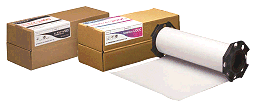 To better meet the variety of possible applications for Thermoscale, Fuji Film has developed this product family with two different measurement ranges,
allowing it to address at least the most significant applications. Specifically, the Thermoscale 200 film covers temperature ranges between 80°C
and 105°C. In manufacturing and production environments, there are numerous situations that require the verification of correct thermal distribution on
a surface, as well as the precise evaluation of the related intensity. The ability to control these important parameters allows for the verification
and fine-tuning of heating elements, ensuring their effectiveness, improving production quality levels, and ultimately increasing the repeatability
of the production process. The Thermoscale product range is essentially a method for study, analysis, and verification, which can be advantageously
used in the context of surface heating phenomena without requiring specific expertise or technical knowledge. The use of Thermoscale film is very
simple, fast, and intuitive, requiring no special preparation. From its first use, the image produced with varying shades of gray will provide a
clear visualization of the detected surface heating distribution, which can be interpreted by directly comparing it with the reference color chart
provided.
To better meet the variety of possible applications for Thermoscale, Fuji Film has developed this product family with two different measurement ranges,
allowing it to address at least the most significant applications. Specifically, the Thermoscale 200 film covers temperature ranges between 80°C
and 105°C. In manufacturing and production environments, there are numerous situations that require the verification of correct thermal distribution on
a surface, as well as the precise evaluation of the related intensity. The ability to control these important parameters allows for the verification
and fine-tuning of heating elements, ensuring their effectiveness, improving production quality levels, and ultimately increasing the repeatability
of the production process. The Thermoscale product range is essentially a method for study, analysis, and verification, which can be advantageously
used in the context of surface heating phenomena without requiring specific expertise or technical knowledge. The use of Thermoscale film is very
simple, fast, and intuitive, requiring no special preparation. From its first use, the image produced with varying shades of gray will provide a
clear visualization of the detected surface heating distribution, which can be interpreted by directly comparing it with the reference color chart
provided.
Fuji Thermoscale Film 200: Key Features
Fuji Thermoscale Film 200: Technology Overview
Thermoscale films are available only in single-sheet format (mono sheet type). This single-sheet type consists of a sensitive PEN film, on which an extremely uniform layer of microcapsules is deposited (using proprietary PSC - Particle Size Control technology). These microcapsules contain a substance capable of changing color based on the color developer material, which, as the temperature increases, penetrates the membranes of the microcapsules.
When the Thermoscale film is subjected to surface heating, the color developer material becomes more fluid, and the walls of the microcapsules containing the dye become permeable, allowing the color developer material to penetrate. The new color density thus determined can be visually appreciated (on the glossy side of the film) using the provided color scale.
If you have any doubts, further useful information can be obtained by consulting the FAQ Thermoscale
Fuji Thermoscale Film 200: Technical Specifications
(*) Tempo di contatto = da 5 a 20 secondi.
(*) Depending on the usage conditions (such as contact time, type of material, pressure, and possible ventilation), the temperature range for using the film may vary.
- The color gradations shown in the instruction manuals provided have been reproduced by Fuji Film under test conditions: calibration must be carried out under actual usage conditions to ensure accurate temperature correspondence.
Fuji Thermoscale Film 200: Usage Instructions
It is recommended to prepare the Thermoscale 100 film well in advance of the test to allow the films to acclimate to the environmental conditions in which they will actually be used. Unroll an appropriate amount of film for the test to be conducted, ensuring that it is placed on a clean, dry surface, preferably in a dimly lit area: these preparatory actions will allow the films to lie flat, simplifying the subsequent cutting and positioning operations described in the sequence below. During these operations (and those that follow), place only the glossy sides of the films on the work surfaces (the matte sides are, in fact, those that will collectively determine the density and distribution of the recorded coloration), to avoid any accidental contact that could affect the films before the tests.
Fuji Thermoscale Film 200: Reference Documentation
Fuji Thermoscale Film 200: Main Applications
Thermoscale films have been advantageously used in applications such as the following:
It is also recommended to review the following literature:
©1998-2024 Spare sas
In preparing this document, the utmost care has been taken to ensure that the content accurately reflects the characteristics of the described product. However, despite these efforts, Spare sas cannot be held responsible or liable for any inaccuracies. Furthermore, in the context of ongoing product development and improvement, please note that the information provided may not be up-to-date with the latest version, as manufacturers reserve the right to withdraw or modify their product documentation at any time without notice. Consequently, it is advised to verify the accuracy and currency of the information at the time of purchase.