- editorial prepared by: Spare sas - prepared by (author): marketing department - section: Press Releases and Technical Articles
Press Release
Nip pressure - verification and analysis systems for the design and fine-tuning of contact areas between rollers and calenders
The increasing market competitiveness, the consolidation of quality standards, continuous technological advancements, and a growing number of diverse
application scenarios have progressively highlighted the lack of effective systems for addressing increasingly specialized and sophisticated diagnostic,
verification, and study needs.
Monitoring the "nip pressure" module, recording the correct parallelism between rollers and calenders, and identifying defects, dirt, grooves, and
indentations in the rollers' coating materials (necessary for the advancement of the processed product) are just a few of the situations where
visualizing and verifying the actual distribution of pressures on any contact surface can provide significant advantages in identifying and correcting
anomalies, ultimately optimizing the production process.
In response to these needs, the well-known Japanese company Fuji Film has long developed a special film that "imprints" according to the
pressure applied to it, effectively providing a clear trace that allows for the precise identification of contact zones and the amount of
pressure exerted on every small portion of the contact area.
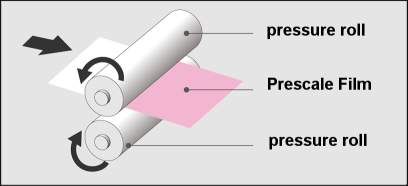
The Prescale film essentially consists of a film coated with a highly uniform layer of microcapsules containing a coloring substance
(Particle Size Control technology). There is also an additional film coated with a material necessary for developing and stabilizing the
colorant. When pressure is applied to the Prescale film, it causes some of these microcapsules to burst. Depending on the number of capsules
broken and the amount of compression applied, the other section of the film will be colored in various shades of red, with the density of the
color being directly proportional to the applied pressure.
Monitoring possible ovalization of rollers, checking their wear, verifying the flatness of their contact area (even across their entire length),
and performing checks and optimizations following their replacement are just a few of the cases where the Prescale film can be beneficial.
Among the most common applications are:
- paper industry machines;
- offset printing machines;
- fabric printing and embossing machines;
- office machines (copiers, plotters, printers, etc.);
- packaging machines (food & pharma);
- laminating machines;
- printed circuit board coating machines;
- calendering machines;
- etc.
The film can be cut to size with simple scissors and placed in the area of interest for both static and dynamic measurements. By performing a
visual check using colorimetric charts provided with the film (or through appropriate electronic analysis tools available separately), it is
possible to identify the different color gradations developed on the Prescale film. This allows the operator to generate a documented test
report and provides the option to create a historical record of inspections conducted over time.
The Prescale film is available in eight different gradations (5LW, 4LW, LLLW, LLW, LW, MW/MS, HS, HHS), allowing measurement ranges between
0.006/0.05 MPa and 130/300 MPa. All versions ensure a measurement accuracy no worse than +/-10%FS (which can be significantly improved when
the film is used in conjunction with appropriate analysis instruments). For more details and technical literature, please visit the website
www.prescale-film.com.


You are here: press · prescale nip Description: Press Release: Verification and Analysis of Contact Pressures Between Rollers and Calenders
- editorial prepared by: Spare sas
- prepared by (author): marketing department
- section: Press Releases and Technical Articles
Press Release
Nip pressure - verification and analysis systems for the design and fine-tuning of contact areas between rollers and calenders
The increasing market competitiveness, the consolidation of quality standards, continuous technological advancements, and a growing number of diverse application scenarios have progressively highlighted the lack of effective systems for addressing increasingly specialized and sophisticated diagnostic, verification, and study needs.
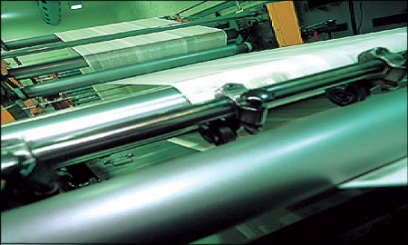
Monitoring the "nip pressure" module, recording the correct parallelism between rollers and calenders, and identifying defects, dirt, grooves, and indentations in the rollers' coating materials (necessary for the advancement of the processed product) are just a few of the situations where visualizing and verifying the actual distribution of pressures on any contact surface can provide significant advantages in identifying and correcting anomalies, ultimately optimizing the production process.
In response to these needs, the well-known Japanese company Fuji Film has long developed a special film that "imprints" according to the pressure applied to it, effectively providing a clear trace that allows for the precise identification of contact zones and the amount of pressure exerted on every small portion of the contact area.
The Prescale film essentially consists of a film coated with a highly uniform layer of microcapsules containing a coloring substance (Particle Size Control technology). There is also an additional film coated with a material necessary for developing and stabilizing the colorant. When pressure is applied to the Prescale film, it causes some of these microcapsules to burst. Depending on the number of capsules broken and the amount of compression applied, the other section of the film will be colored in various shades of red, with the density of the color being directly proportional to the applied pressure.
Monitoring possible ovalization of rollers, checking their wear, verifying the flatness of their contact area (even across their entire length), and performing checks and optimizations following their replacement are just a few of the cases where the Prescale film can be beneficial.
Among the most common applications are:
- paper industry machines;
- offset printing machines;
- fabric printing and embossing machines;
- office machines (copiers, plotters, printers, etc.);
- packaging machines (food & pharma);
- laminating machines;
- printed circuit board coating machines;
- calendering machines;
- etc.
The film can be cut to size with simple scissors and placed in the area of interest for both static and dynamic measurements. By performing a visual check using colorimetric charts provided with the film (or through appropriate electronic analysis tools available separately), it is possible to identify the different color gradations developed on the Prescale film. This allows the operator to generate a documented test report and provides the option to create a historical record of inspections conducted over time.
The Prescale film is available in eight different gradations (5LW, 4LW, LLLW, LLW, LW, MW/MS, HS, HHS), allowing measurement ranges between 0.006/0.05 MPa and 130/300 MPa. All versions ensure a measurement accuracy no worse than +/-10%FS (which can be significantly improved when the film is used in conjunction with appropriate analysis instruments). For more details and technical literature, please visit the website www.prescale-film.com.
©1998-2024 Spare sas
In preparing this document, the utmost care has been taken to ensure that the content accurately reflects the characteristics of the described product. However, despite these efforts, Spare sas cannot be held responsible or liable for any inaccuracies. Furthermore, in the context of ongoing product development and improvement, please note that the information provided may not be up-to-date with the latest version, as manufacturers reserve the right to withdraw or modify their product documentation at any time without notice. Consequently, it is advised to verify the accuracy and currency of the information at the time of purchase.